9/11/2026 • 7 min read
Today, companies have tools that tell them where their data is stored, who can access it, and how their systems are protected. However, once a legitimate user accesses data, they often lose visibility into what happens to it.
An employee may be perfectly authorized to view a file containing customer data. But does that mean they should be able to download thousands of customer records? Copy them to their personal device? Share them with a third-party provider? Upload them to a generative AI tool?
Data Usage Visibility aims to close this blind spot by giving organizations and business teams a clear view of how their data is actually being used.
Data Usage Visibility refers to the ability to observe and contextualize how data is actually used across an organization’s information systems. It provides visibility into essential elements that are often difficult to connect: who is using which data, when, from what environment and, most importantly, for what purpose.
This lack of visibility is far from marginal. According to Salesforce, more than six in ten Data, Analytics, and IT leaders say they lack visibility into key metrics, including data usage.
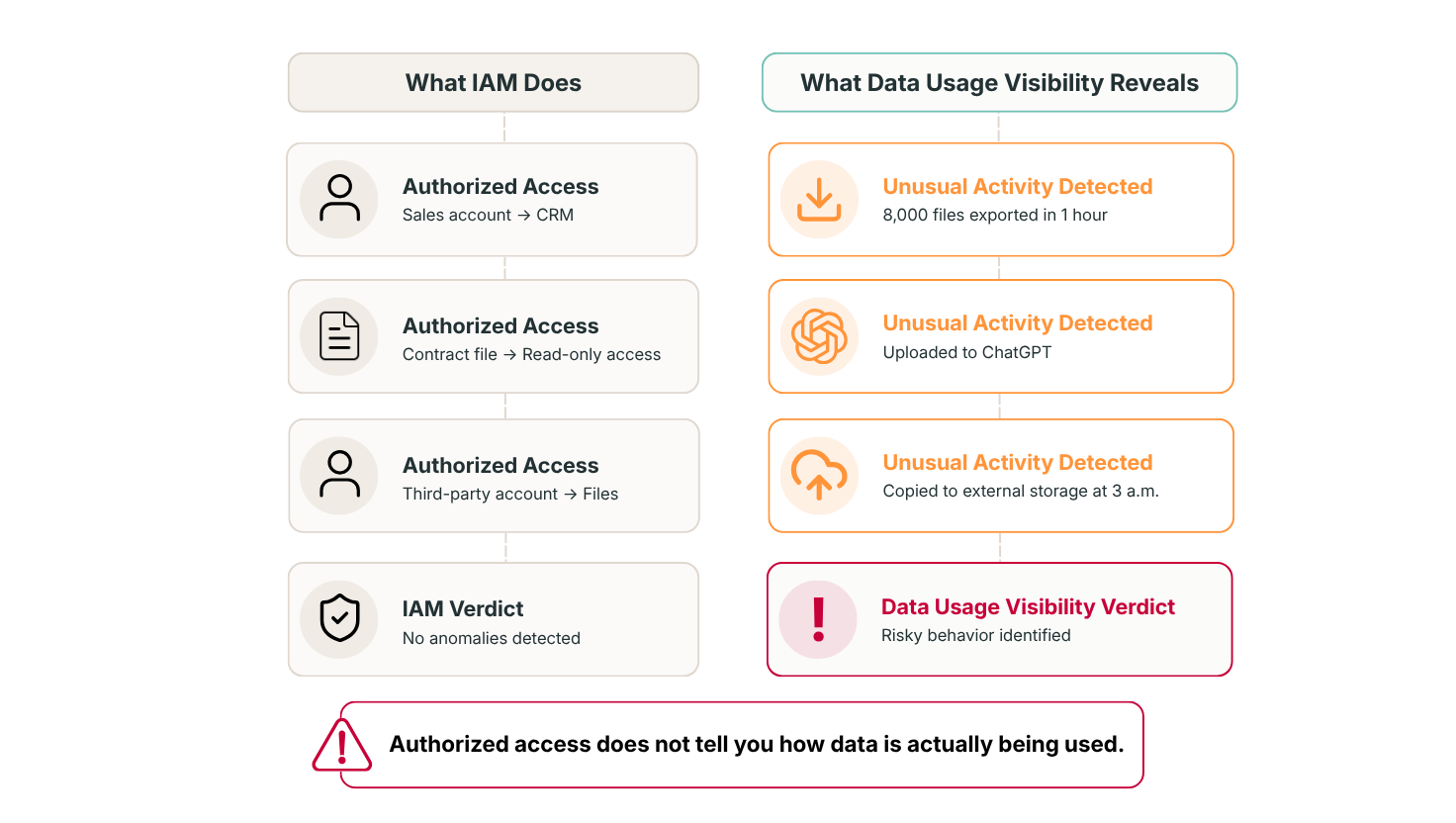
Traditional access management mechanisms can tell you, for example, that a user belongs to the finance department and is authorized to view certain documents. Data Usage Visibility goes further by revealing that the same user has just downloaded 3,000 files, copied them to an external location, or handled an unusual volume of sensitive information.
In other words, there is a fundamental difference between theoretical access rights and actual data usage.
Key takeaway: Data Usage Visibility is not just about knowing who can access data. It is about understanding what users and applications actually do with that data once access has been granted.
IAM, RBAC, PAM, least-privilege policies: identity and access management is one of the pillars of modern cybersecurity.
These mechanisms primarily answer one question: is this user authorized to access this resource?
But an action can be technically authorized and still create risk.
Consider a salesperson who legitimately has access to the CRM. Viewing a few dozen customer records each day is part of their normal activity. Yet exporting the entire database a few days before leaving the company involves exactly the same account and the same permissions.
From an access control perspective, no rule has necessarily been violated.
From a data risk perspective, the situation is entirely different.
This is one of the limitations of security models focused exclusively on permissions: a legitimate identity can still result in illegitimate—or simply dangerous—use of data.
The challenge becomes even more complex with privileged accounts, third-party providers, SaaS applications, and machine identities, whose access can involve enormous volumes of information.
For a long time, information security was primarily built around infrastructure: endpoints, networks, servers, applications, and identities.
The widespread adoption of cloud, SaaS, hybrid work, and now generative AI has made this approach increasingly insufficient.
The same piece of data can now be created in a business application, synchronized with a cloud service, downloaded to an endpoint, sent via email, shared with a third party, and then copied into another environment.
The technical perimeter changes. The data keeps moving.
This movement makes data usage increasingly difficult to track: 72% of organizations say they lack visibility into how users interact with sensitive data across endpoints, cloud, and SaaS environments. (Cybersecurity Insiders, 2025)
Visibility into data usage complements access controls and addresses a broader challenge: ensuring that data is used in a controlled way and in accordance with organizational policies.
The rapid adoption of artificial intelligence tools illustrates this challenge particularly well.
An employee might upload a contract, a piece of source code, a customer file, or a strategic document to an AI tool simply to save time.
The intent is not necessarily malicious. On the contrary, the user is often simply trying to work more efficiently.
Systematically banning new tools rarely provides a sustainable solution. Digital practices evolve faster than internal policies, and the rise of Shadow AI is reproducing, on a much larger scale, a problem already seen with Shadow IT.
Understanding how data is being used therefore becomes essential to striking the right balance between innovation and risk management.
Without visibility, organizations are left with two imperfect choices: allow new tools without really knowing what data is flowing through them, or block them broadly as a precaution.
This approach nevertheless raises an important question: how far should organizations go in observing data usage without turning cybersecurity into permanent employee surveillance?
The answer lies, in part, in taking a risk-based approach. The objective is not to give every observed action the same level of attention, but to focus on usage that is risky or unusual based on the data involved, the user, and the surrounding context.
This visibility can also help share responsibility for security more effectively with business teams. The CISO should not be expected to decide alone what constitutes legitimate or risky data usage. Business teams understand their data, its value, and how it is supposed to be used. Giving them greater visibility into actual usage allows them to play a more active role in identifying and addressing the risks that affect them.
Visibility should therefore be designed around the sensitivity of the data and the risk associated with its use. An action involving public documentation does not require the same level of scrutiny as an extraction of health data, financial information, or intellectual property.
In other words, the value lies not simply in seeing how data is used, but in identifying which events genuinely deserve attention and escalating them to the right level of responsibility.
This approach also helps reduce noise for security teams. The goal is not to generate more alerts, but to focus analysis on events involving the data that matters most to the organization.
Key takeaway: The goal is not to monitor every use of data in the same way, but to highlight activity that creates risk for the most sensitive data. Data Usage Visibility delivers its greatest value when it contextualizes observed actions and helps security and business teams focus on the situations that truly matter.
Users work from everywhere. Applications communicate with one another. Data constantly moves between infrastructures that, in some cases, are not even owned by the organization.
In this fragmented environment, reasoning solely in terms of systems, applications, or identities quickly shows its limitations. Sensitive data does not stop being sensitive when it leaves the CRM and is downloaded to an endpoint. What changes is the context in which it is used—and therefore, potentially, the level of risk.
Data becomes a particularly useful reference point for connecting events that, when viewed individually, may appear perfectly legitimate. When those events involve an unusual volume of sensitive data, occur in an unexpected context, or result in a transfer to an external environment, their significance changes.
Adopting a more data-centric approach therefore means preserving the context of data throughout its journey: knowing what is sensitive, where it is located, who accesses it and, above all, what is actually being done with it.
For a long time, knowing where data was located and who could access it provided a satisfactory level of control. That is no longer enough. Access authorization and actual usage are two different things, and the gap between them has widened with recent innovations such as generative AI.
Data Usage Visibility is not simply another security layer to add to the existing stack. It represents a shift in perspective: from systems to data, from access to usage, and from policy to observing what actually happens.
Want to learn more? Contact ustoday to discuss your data security challenges.