
6/12/2026 • 5 min read
What if the greatest cyber risk wasn't technical?
When an organization loses the trust of its ecosystem, the consequences can extend far beyond the initial incident.
€4.2 million: that's the average global cost of a data breach in 2024 (IBM, 2025). A staggering figure, yet it doesn't tell the whole story. Behind technical remediation costs and regulatory fines lies a much more enduring and often underestimated form of damage: reputational harm.
Loss of customers, stock market declines, partner distrust, recruiting difficulties—reputational damage from a cyberattack never appears on an invoice, but organizations can pay for it for years.
When managing cyber risk, CIOs and CISOs naturally focus on direct costs: ransom payments, system restoration, regulatory notifications, and GDPR penalties. These costs are measurable, immediate, and budgetable.
Reputational damage, however, is latent. It often emerges months after the incident and its effects can persist long after the technical recovery is complete. Precisely because it is difficult to quantify, it is frequently overlooked in risk assessments.
Key takeaway: A cyberattack does not end when systems are restored. The real work often begins afterward, when organizations must rebuild trust with customers, partners, and markets.
When a company discloses a cyberattack, customer reactions are rarely immediate. Instead, they unfold gradually and are often difficult to reverse.
Documented case studies show that organizations affected by data breaches experience significant customer attrition in the months following an incident. This erosion of trust directly translates into lost revenue.
The pattern is familiar: customers learn that their personal information—contact details, payment information, or purchase history—may have been exposed. They do not necessarily leave immediately, but when the next contract renewal or supplier evaluation comes around, the memory of the incident influences their decision.
For B2B organizations, the effect can be even more severe. Large enterprises often act quickly: security clauses are invoked, supplier audits are launched, and in the most serious cases, contracts are terminated.
According to Netwrix, in 2024, 20% of organizations affected by a cyberattack reported losing a competitive advantage as a result of the incident.
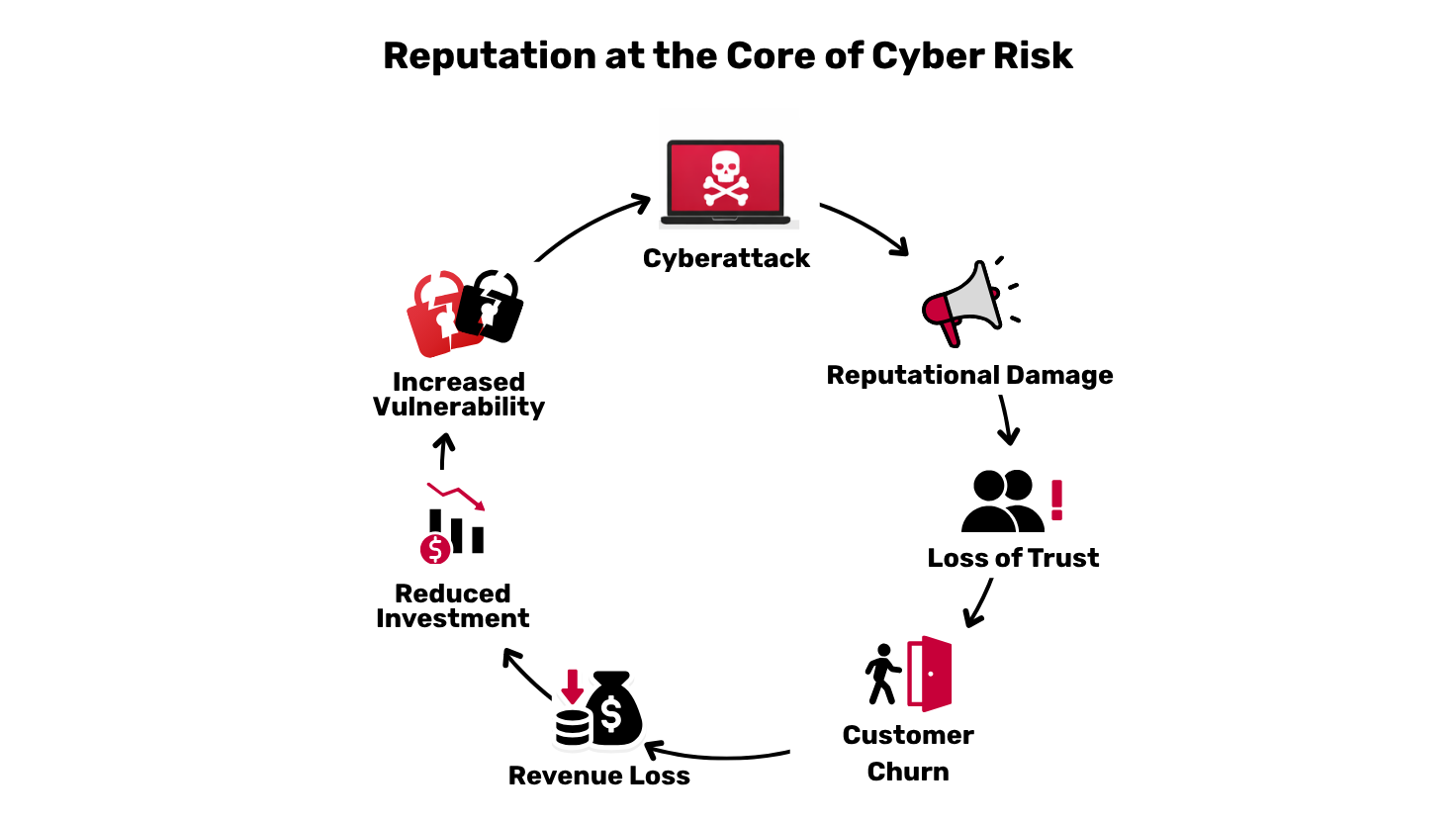
For publicly traded companies, reputational consequences are immediate and measurable.
Studies conducted on large samples of listed companies estimate an average stock price decline of 1% to 5% in the days following the disclosure of a cyberattack (AMF, 2020).
While this may seem modest, for organizations valued at several billion euros, it represents a significant destruction of value within hours.
Microsoft's July 2024 DDoS attack, which severely disrupted Azure services, contributed to a decline in the company's stock price over the following days, in an environment already impacted by earnings announcements.
Markets do not merely react to operational disruption. They also respond to the perception of inadequate cyber governance.
And that perception can persist. Institutional investors increasingly incorporate cyber maturity into ESG criteria. Organizations that suffer major incidents without demonstrating a credible response plan may see their risk profile downgraded, increasing their cost of capital over the medium term.
A data breach reported to the CNIL or another European supervisory authority rarely remains confidential.
Regulatory decisions are made public, often with uncomfortable levels of detail regarding the failures identified.
In France, notifications to the CNIL increased by 20% in 2024. Every notification sends a signal to customers, partners, and competitors: a vulnerability existed, data was exposed, and legal obligations had to be triggered.
In sectors such as healthcare, finance, and critical infrastructure, this visibility alone can be enough to trigger contract reviews or termination procedures among risk-sensitive clients.
Key takeaway: Regulation does more than impose financial penalties. It makes incidents visible, documented, and actionable, transforming a technical crisis into a public communications crisis.
Reputation is also built within an ecosystem.
Suppliers, subcontractors, and technology partners continuously assess the level of risk associated with their business relationships. An organization that experiences a major cyberattack can quickly become perceived as a source of potential risk.
This is the phenomenon of reputational contagion.
It is not enough for your company to be affected. If the incident is perceived as the result of systemic negligence rather than a sophisticated attack, demanding partners may begin reassessing their engagement.
Today, cybersecurity maturity questionnaires are commonplace in procurement processes, and a recent security incident can be enough to disqualify a bidder.
Less frequently discussed but equally real: a highly publicized cyberattack can damage an organization's employer brand.
Technical professionals—including developers, security architects, and cloud engineers—are in high demand. They often choose employers based, in part, on the strength of their security posture. A public cyber incident sends the opposite message.
According to IBM's 2024 research, 70% of organizations affected by a data breach reported significant or very significant operational disruption.
These disruptions become visible. They are discussed internally, shared across professional networks, and can weaken employee confidence.
Meanwhile, teams that managed the crisis under intense pressure often experience fatigue and burnout. Subsequent departures only increase the organization's vulnerability.
The total reputational cost of a cyberattack remains difficult to model precisely, but the overall conclusions are becoming increasingly clear.
According to research by Bessé, the primary driver of post-incident economic deterioration is often a crisis of reputation and trust rather than direct technical costs.
Transparency plays a decisive role.
Organizations that communicate quickly, clearly, and responsibly significantly reduce reputational damage. Those that minimize the incident, delay communication, or hide behind technical jargon often make the crisis worse.
The question is no longer whether your organization will be targeted, but when.
And when an incident occurs, a technical response alone will not be enough to protect what may have taken years to build: customer trust, brand credibility, and strong partner relationships.
Investing in cybersecurity is not only about protecting systems and data. It is also about safeguarding an intangible asset whose value may never appear on a balance sheet, but whose loss is felt in every line of the income statement.
Want to learn more about this topic? Our experts are available to answer your questions.