
3/14/2026 • 5 min read
Artificial intelligence has quickly become a key tool in the workplace. By 2025, 90% of organizations reported that their employees were using generative AI applications (Netskope, 2025). Tools such as ChatGPT, Gemini, Copilot, and Mistral AI are now commonplace across a variety of professional and personal contexts. While this rapid adoption highlights their efficiency and potential, it also raises important questions about data security.
In professional settings, employees may inadvertently share sensitive information with these tools—whether out of habit or a lack of awareness. This can include contracts containing trade secrets, strategic documents, or highly sensitive personal, medical, or financial data. Such behavior, often underestimated, exposes organizations to potential data leaks with serious consequences.
Despite its enormous potential, AI operates within a regulatory landscape that is still evolving. Significant uncertainties remain regarding how shared data is handled. Each provider applies its own privacy policies: Gemini, in accordance with local laws, reserves the right to use your data for commercial purposes (Gemini, 2025). OpenAI does not sell user data for behavioral advertising (OpenAI, 2025), while Microsoft Copilot may share certain data for personalized advertising purposes but does not sell it (Copilot, 2025). Data can also pass through third-party providers or be exposed to technical vulnerabilities.
The hype around large language models (LLMs) often overshadows the new risks they pose to organizations. This is not just an issue for large corporations—small and medium-sized businesses, often less equipped with cybersecurity tools, are equally vulnerable. Public institutions, which handle strategic data daily, also cannot afford to rely on unsecured services.
In 2023, several Samsung employees unintentionally exposed sensitive company data by sharing it with ChatGPT (RFI, 2023). Their goal was to save time by having the tool rephrase internal reports and optimize source code. By entering confidential information into an external service, they allowed it to be stored and potentially exploited by an outside party. The documents shared included technical details as well as elements of the company’s strategic plans.
This incident highlights the dangers of uncontrolled AI use in professional settings. Even seemingly harmless actions—like asking a chatbot to rephrase an internal document—can compromise a company’s security.
Some organizations have taken extreme measures, such as completely blocking LLM access on workstations to eliminate the risk of data leaks. If employees cannot access these tools, they cannot transmit sensitive information.
However, this approach comes at a cost. Completely blocking access also removes the productivity and innovation benefits that AI can offer, such as speeding up content creation, structuring ideas, automating repetitive tasks, and supporting strategic monitoring. Rejecting AI may slow innovation, hinder processes, and make an organization less competitive.
Other companies deploy LLMs on local infrastructure rather than using cloud services. By hosting these models in-house, organizations retain full control over the data processed, minimizing the risk of leaks.
Still, this solution has limitations. Setting up and maintaining internal models requires significant technical resources, including computing power, storage, and skilled personnel. Performance may also lag behind cloud-based solutions, particularly for complex or specialized tasks. Even with a secure setup, human error remains a risk. A careless or malicious employee can still use a public LLM service, and a single query containing sensitive information could result in a leak.
Rather than banning AI, a more effective strategy is to regulate its use. This is the approach developed by Daspren. The goal is to let organizations harness AI’s advantages while protecting sensitive data.
Daspren’s solution maps digital tool usage in real time across the company. Every interaction between an employee and an AI tool can be monitored, analyzed, and controlled. This transparency allows IT teams to quickly identify risks without stifling innovation or productivity.
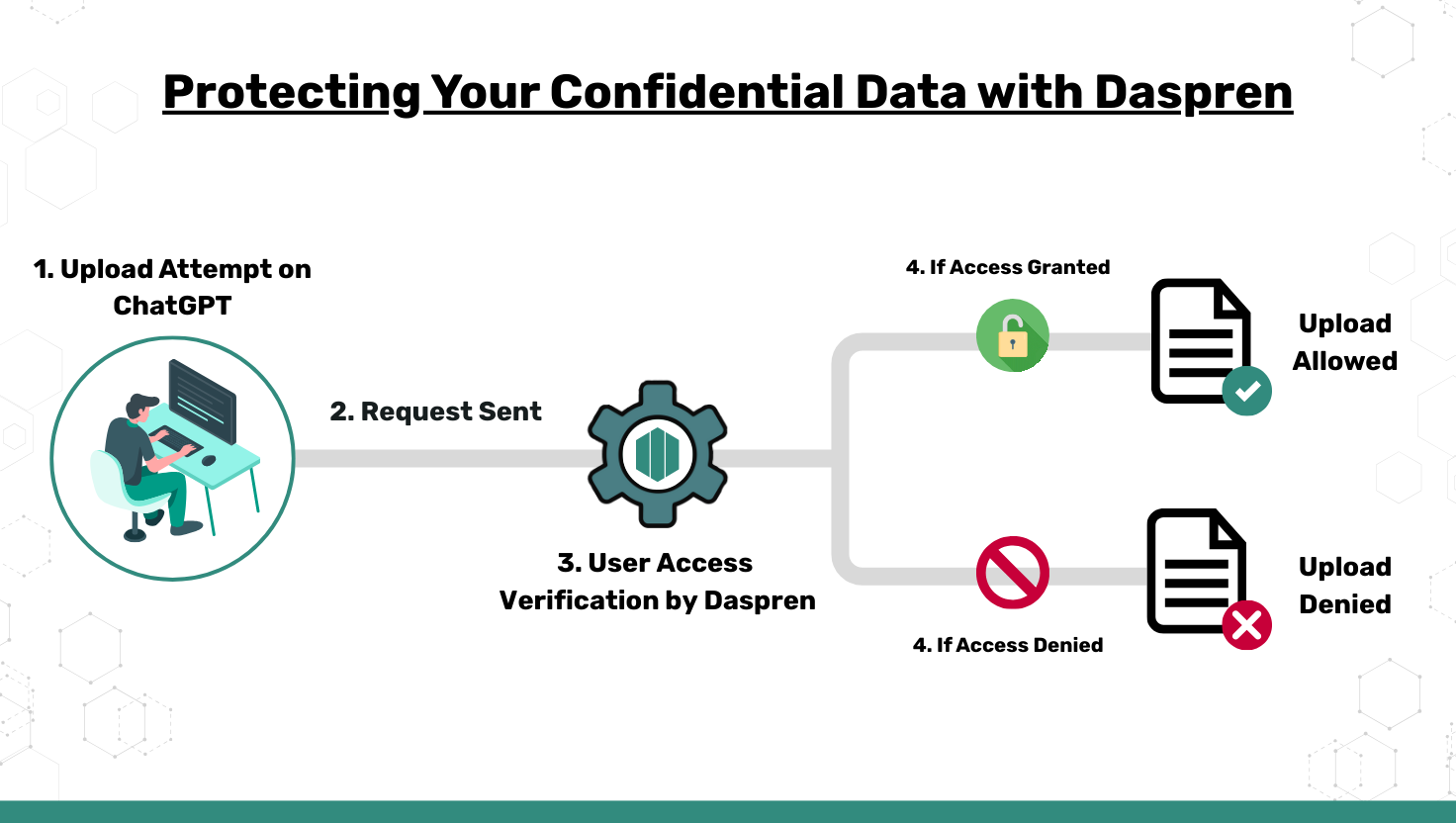
The software also allows organizations to define rules based on document sensitivity. Strictly confidential data can be blocked from being sent to unauthorized LLMs. Protection groups further restrict user actions based on role or access level, while contextual alerts guide employees and raise awareness about data privacy risks.
AI has rapidly become central to modern workplace practices. To prevent it from becoming a vulnerability, its use must be carefully managed. The goal is not to hinder innovation but to guide it responsibly, using the right tools and practices.
By balancing performance and security, organizations can fully leverage AI’s potential while maintaining complete control over their sensitive data.
Want to learn more? Contact us today for a personalized demo.